EU - Mercosur: towards a new era for global trade ?
Following over 25 years of negotiations, the European Union and the Mercosur bloc (Argentina, Brazil, Paraguay, Uruguay, and Bolivia) offically signed their landmark free trade agreement on January 17, 2026. The signing ceremony took place at the Central Bank of Paraguay in Asunción - the symbolic site where Mercosur was founded in 1991. This event marks the birth of the world’s largest free trade area, covering 750 million people and representing nearly 20% of global GDP.
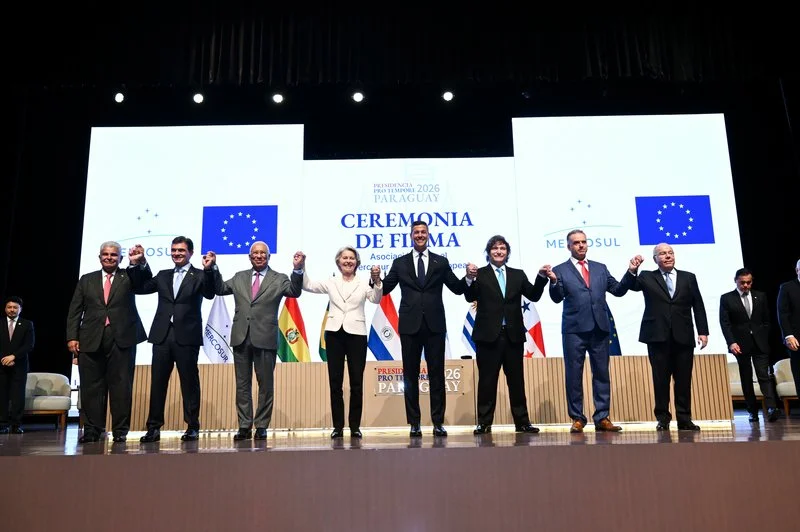
EU Comission President Ursula Von Der Leyen and MERCOSUR head of States celebrate the signing of the free trade agreement on January 17, 2026 - European Union
In a global context defined by rising protectionism, including potential U.S. tariffs and China’s growing influence in Latin America, this agreement is a vital tool for "strategic sovereignty". It secures a "first-mover" advantage for the EU, as no other major economic bloc has a comparable deal with Mercosur. This partnership is essential for building resilient supply chains and mitigating the risks of economic coercion by diversifying trade partners.
The pact will eliminate duties on 91% of EU exports and 92% of Mercosur exports and European businesses are projected to save over €4 billion ($4.6 billion) annually in customs duties, which is eight times the savings offered by the EU-Canada agreement.
Significant tariff removals (often reaching 35%) will benefit the automotive, chemical, pharmaceutical, machinery, and textile sectors. For instance, Mercosur will liberalize 90% of its industrial imports from the EU. The EU already maintains a €15.7 billion trade surplus in services with Mercosur. The deal grants EU companies unprecedented, non-discriminatory access to public procurement markets, allowing them to bid for contracts with government agencies on equal footing with local firms.
The agreement is also instrumental in securing a sustainable supply of critical raw materials (CRMs), vital for Europe’s digital and green transitions. More specifically, the following materials are expected to be key trade items:
Niobium: Brazil already provides 82% of the EU’s supply, which is essential for high-strength steel used in infrastructure.
Lithium: Argentina is a global leader in lithium processing, a core component for EV batteries.
Graphite and Silicon: access to these materials will be streamlined, reducing costs for EU technology and battery manufacturers.
The latest rounds of negotiations between the two blocs focused on sustainability and how it should be at the core of the upgraded agreement, with commitments that are now legally binding.
The text includes a binding commitment to stop deforestation by 2030, the first time such a clause has been subject to dispute settlement in an EU trade deal. Moreover, respect for the Paris Climate Agreement is an "essential element"; its breach could lead to the suspension of trade preferences. In addition, both parties commit to International Labour Organization (ILO) standards, including the fight against forced and child labor.
Despite its strategic value, the deal faced "fierce resistance" from the agricultural sectors of France, Poland, Ireland, Hungary, and Austria. To protect European farmers from a surge of cheaper imports, the EU has integrated several shields:
Strict Quotas: sensitive products like beef are limited to 99,000 tons at a 7.5% duty, representing only 1.5% of EU production.
Crisis Fund: a €6.3 billion fund has been established to support EU farmers through market transitions.
Rebalancing Mechanism: a new safeguard allows any party to request a ruling if they feel their benefits are being impaired by the other party's measures.
Geographical Indications (GIs): over 350 European products (e.g., Champagne, Feta, Polish Vodka) will be protected from imitations in Mercosur.
“We are creating the largest free trade zone in the world, a market worth almost 20% of global GDP. Delivering untold opportunities for our 700 million citizens. This agreement sends a strong signal to the world. It reflects a clear and deliberate choice. We choose fair trade over tariffs, we choose a productive, long-term partnership, and above all, we intend to deliver real and tangible benefits to our peoples and companies.”
Ursula Von der Leyen, President of the European Commission, during her speech at Asunción, Paraguay on Saturday 17, January 2026.
2026 Perspectives: toward a 1.1 billion person market
While the signing in Paraguay is a historic milestone, hurdles remain in the path to full implementation. The agreement now moves to the European Parliament for a vote, likely in the spring of 2026. While some MEPs may seek a referral to the European Court of Justice to verify the deal's legal validity, the momentum for provisional entry into force is high.
In the long term, considering existing trade agreements and associated countries to both blocs, bilateral trade flows could increase by up to 70%, eventually creating an integrated economic space of 1.1 billion people with a combined GDP comparable to that of the United States.