Venezuela: what’s next after Maduro’s downfall ?
U.S. special forces captured Venezuelan President Nicolás Maduro in daring Caracas raid, marking a turning point in regional geopolitics and U.S. intervention.
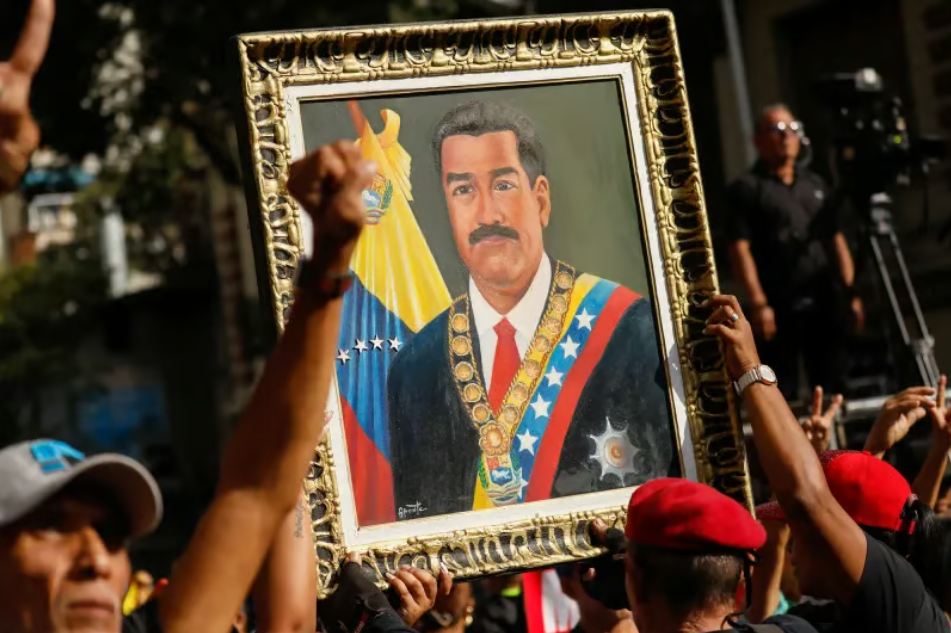
A portrait of the ousted Venezuelan President Nicolás Maduro at a demonstration in Caracas, January 2026 - Leonardo Fernandez Viloria / Reuters
On January 3, 2026, U.S. special forces conducted a daring raid in Caracas, capturing President Nicolás Maduro and his wife. The operation, although swift and without American casualties, resulted in the deaths of at least 80 people, including Cuban and Venezuelan soldiers and civilians. Maduro was transferred to New York where he was tried for narcoterrorism and drug trafficking.
President Donald Trump stated that the United States would "run the country" on an interim basis until a transition deemed "appropriate" takes place. Currently, Vice President Delcy Rodríguez has been recognized by Washington as interim president, although the actual control of the country remains unclear.
Main challenges ahead
The overthrow of Maduro raises critical questions about the country's governance and resources
Energy control: one of the central objectives is to regain access to Venezuela's oil reserves, the largest in the world. Trump explicitly mentioned the return of American oil companies. The US President claimed that “30 to 50 million barrels” of Venezuelan oil would be sold to the USA at market price. However, the industry has been degraded by years of mismanagement and requires massive investment.
Political transition: Although Delcy Rodríguez is in power, she must contend with internal rivals like Diosdado Cabello, who controls armed militias (colectivos). Furthermore, the opposition, led by María Corina Machado and Edmundo González (the winner of the 2024 election), is demanding genuine democratization, although Trump currently considers those two figures unable to rule the country.
Internal security: The country remains plagued by gangs, cartels, and paramilitary groups. If the regime collapses without an orderly transition, Venezuela could descend into a protracted guerrilla conflict.
Possible scenarios in post-Maduro Venezuela
Three main trajectories seem can be identified for Venezuela in the near future:
Negotiated Transition (Best-Case): Regime elites, fearing prosecution, negotiate their departure in exchange for amnesty, allowing the legitimate opposition to take power and stabilize the economy. An upcoming meeting between Donald Trump and Corina Machado in Washington should determine wether or not this scenario remains relevant.
US-Managed Continuity: Washington keeps Rodríguez in power under close supervision in exchange for privileged access to oil and cooperation on immigration, without radical changes to the internal system. So far, this is the most likely scenario since Donald Trump seems open to maintaining good relations with Delcy Rodriguez.
Fragmentation and Chaos (Worst-Case): The regime's supporters' refusal to concede leads to asymmetric warfare. Institutions fracture, triggering a new humanitarian and migration crisis.
The attack marks the resurgence of the Monroe Doctrine, rebranded as the "Trump Corollary," or “Donroe” doctrine. It revives American dominance in the Western Hemisphere. Secretary of State Marco Rubio recently highlighted this in an interview:
“This is the Western Hemisphere. This is where we live, and we’re not going to allow the Western Hemisphere to be a base of operation for adversaries, competitors and rivals of the United States.”Marco Rubio, US Secretary of State, on NBC Meet the Press, June 4, 2026.
Impact on the region
Consequently, the US intervention in Venezuela could trigger more changes in the region in the months to come:
Pressure on Cuba: The island, heavily reliant on Venezuelan oil, faces the risk of complete blackouts. A halt in deliveries could trigger massive protests and threaten the survival of the Cuban regime.
Tensions with Colombia: Trump directly threatened leftist President Gustavo
Petro, accusing him of complicity in cocaine trafficking. Colombia could become the next target of intervention or intense pressure.
Regional realignments: Right-wing governments (Argentina, El Salvador) support the action, while others (Mexico, Brazil) fear an erosion of regional sovereignty and may seek closer ties with China to counterbalance it.
Oil market: The potential return of Venezuelan oil threatens the market share of Canada (Alberta) and Mexico in the U.S. heavy oil market, which could drive down prices and redirect global investment flows.