Continental integration: Brazil’s multi-billion dollar infrastructure push
South America is entering a transformative era of physical and regulatory integration, driven by a renewed strategic push from Brasília. On February 3rd 2026, the Brazilian government formalized the "South American Integration Routes Program" (Programa Rutas de Integración Sudamericana), a historic initiative aimed at repositioning Brazil as a continental logistics hub. Coordinated by the Ministry of Planning and Budget, this program moves beyond highway construction; it seeks to link Brazil’s industrial and agricultural heartlands with the Pacific coast, creating a land-based alternative to the increasingly congested and climate-vulnerable Panama Canal.

Brazil is pushing for a continental infrastructure program aiming at linking its industrial and agricultural heartlands to the Pacific.
Five strategic arteries for a continental vision
The program is built around five strategic routes designed to integrate all Brazilian states with their neighbors and the Pacific. These corridors represent more than 190 infrastructure projects, including roads, railways, ports, and digital infrastructure.
The program orchestrates five strategic arteries - spanning from the Amazonian north to the flagship Capricorn Bioceanic Corridor - linking Brazil’s industrial heartlands directly to Chilean Pacific ports. The Capricorn Corridor is a 2,400 km network crossing Brazil, Paraguay, Argentina, and Chile. It is expected to facilitate the movement of over 8.6 million tons of goods annually, primarily agro-industrial and mining products, reducing logistics costs by up to 30-40%.
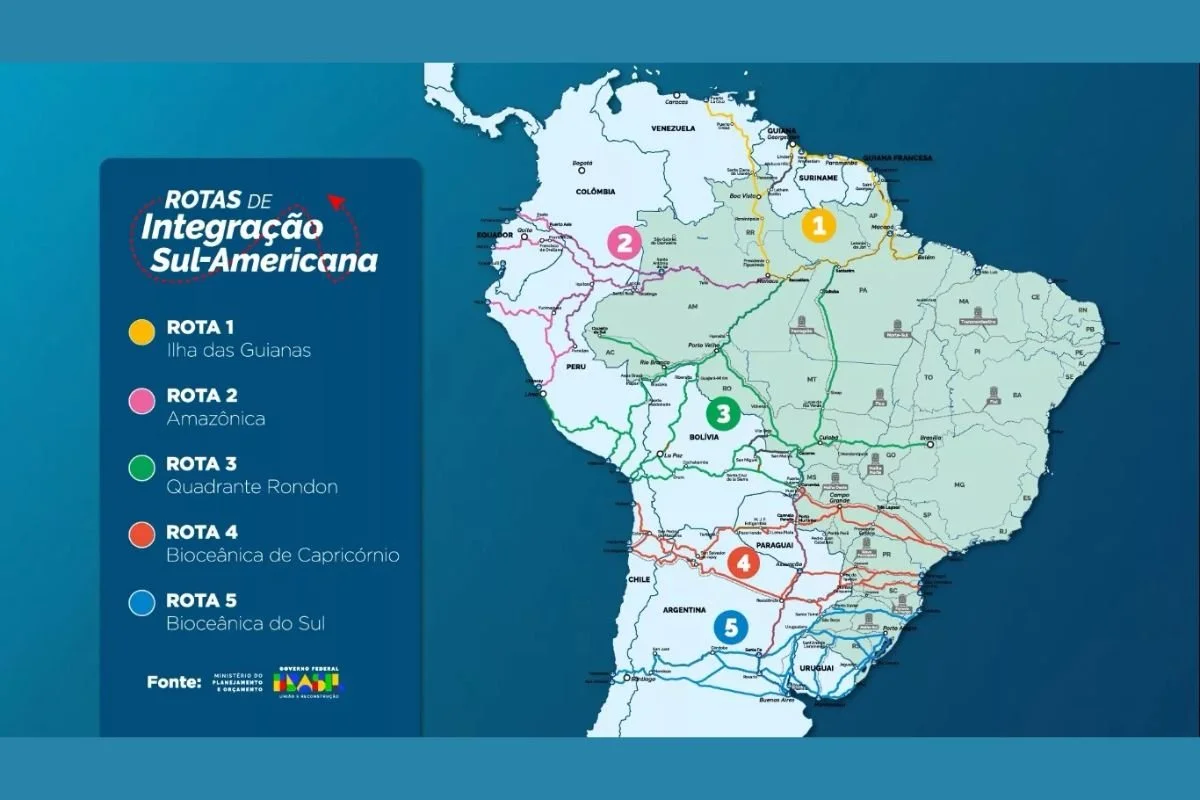
Illustration of the 5 Roads initiative for continental integration impulsed by the Brazilian government
Following the market to the Pacific
The fundamental driver of this "Bioceanic Pivot" is the radical shift in global trade dynamics. More and more, Brazil’s primary trading partners are located across the Pacific in Asia, led by the intense economic expansion of China. By establishing efficient land routes to Chilean ports like Antofagasta and Iquique, South American exporters can bypass the Atlantic-dominated maritime routes, significantly shortening transit times to Asian markets. Brazil and China have become close trade partners and this relation could deepen even further in the future. Brazil’s president Lula recently opened the door for a Mercosur-China partial trade agreement.
Furthermore, the program aims to internalize development. By incorporating 16 non-bordering Brazilian states - which represent 73% of the national GDP - into these routes, Brasília is fostering a "mindfacturing" and export-led industrial strategy that bridges the Atlantic and Pacific systems.
Regulatory and financial catalysts
Integration is no longer just about "concrete and steel". Brazil’s recent ratification of the TIR Convention (to take effect in July 2026) is a key move that will simplify customs procedures and streamline international transit at borders. This regulatory alignment is being mirrored by a massive financial commitment. The program is backed by a $10 billion "Conexión Sur" initiative, with $3 billion from Brazil’s BNDES and $7 billion from regional development banks like the IDB, CAF and Fonplata. The recent 200 million IDB loan to Paraguay for its section of the Bioceanic Corridor highlights the multilateral momentum behind these corridors.
However, despite the high-level political will, significant "above-ground" risks remain regarding this ambitious plan: success depends on the continued alignment of 11 South American nations and the harmonization of disparate customs and sanitary regulations. Moreover, the routes pass through sensitive biomes, including the Chaco and the Amazon. Consequently, the program has established socio-environmental responsibility and "transversality" as core pillars to ensure local communities and biodiversity are protected.
🎯 Strategic perspective
The formalization of the South American Integration Routes could mark the end of South America’s historical "Atlantic-only" focus. By architecting a multi-modal land bridge between two oceans, Brazil is not just building roads; it is creating a sovereign logistics shield. This infrastructure could allow the region to dictate its own trade terms in an era where traditional maritime chokepoints are increasingly vulnerable.