Vaca Muerta: Argentina’s $30B bet
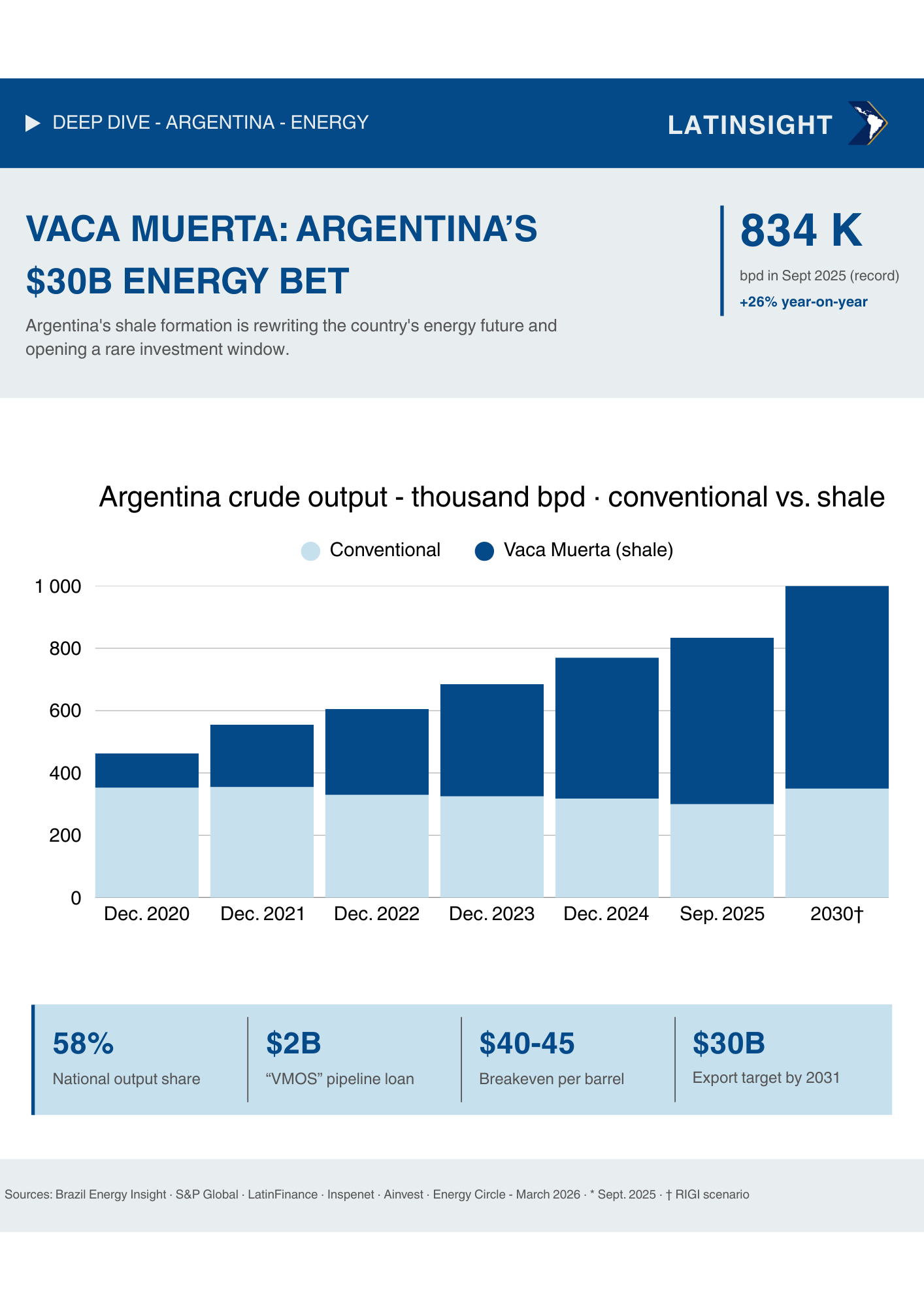
Spanning 8.6 million acres across the Neuquén province, Argentina's Vaca Muerta formation has quietly become one of the most consequential energy stories in the Western Hemisphere. In September 2025, the country's oil production hit a new all-time high of 833,874 barrels per day, with unconventional shale output accounting for 66% of total national production. That share was below 30% just five years ago.
Vaca Muerta holds the world's fourth-largest shale oil reserves and second-largest shale gas reserves, with only around 10% of the formation currently under development. What has changed is the investment climate and especially President Milei's RIGI framework that offers 30-year fiscal stability for investments above $200M. This has unlocked a pipeline of projects. The question is no longer whether Vaca Muerta can produce at scale. It is whether Argentina's infrastructure and institutions can keep pace.
The Vaca Muerta formation represents a huge potential for Argentina’s energy industry
Key takeaways
A structural cost advantage: Vaca Muerta's breakeven price is estimated between $36 and $45 per barrel, well below the $60–70/bbl average for U.S. shale. At current Brent levels around $63, the formation is comfortably profitable to drill. YPF's CEO has stated the company can develop the entire formation profitably at $45/bbl. As U.S. shale costs are projected to rise toward $95/bbl by the mid-2030s, this gap will only widen.
Solving the infrastructure bottleneck: The critical constraint on Vaca Muerta's growth has always been export infrastructure, not geology. That is changing. The $2 billion Vaca Muerta Oil Sur pipeline - the largest private infrastructure loan in Argentine history, arranged by Citi, JP Morgan, Santander, Itaú and Deutsche Bank - will connect Neuquén to an Atlantic export terminal at Punta Colorada by end-2026.
The RIGI investment window: Milei's RIGI framework has been extended to upstream oil and gas projects, offering fiscal certainty and preferential FX access for large-scale investments. The application window has been extended by one year. Thirty-plus projects worth over $33 billion have been submitted. The window is open but investors are watching closely for any signs of political reversal ahead of the 2027 elections.
The investment outlook is not without friction: the Argentine Senate's recent reform to the Glacier Law - covered in our Market Intelligence section - adds a regulatory variable that investors in Neuquén's periglacial zones will need to monitor closely.
LNG as the endgame: Argentina's long-term energy ambition targets $30 billion in annual energy exports by 2030–31. The anchor project is an LNG export terminal led by YPF in partnership with Golar LNG, Pampa Energía and Harbour Energy and described by industry observers as the fastest-moving LNG project globally from planning to approval. First exports are targeted before 2030, which would transform Argentina into a major LNG supplier to Europe and Asia.