Chile’s Power Problem
Chile has spent a decade becoming one of the world’s most impressive renewable energy success stories. It now faces a new challenge: making that energy actually usable. In this analysis from “The Chile Brief”, I focus on the structural challenge at the heart of Chile’s power sector and the government’s response: a strategic roadmap, an emergency bill, and a battery storage boom that is giving Chile a decisive lead in Latin America.
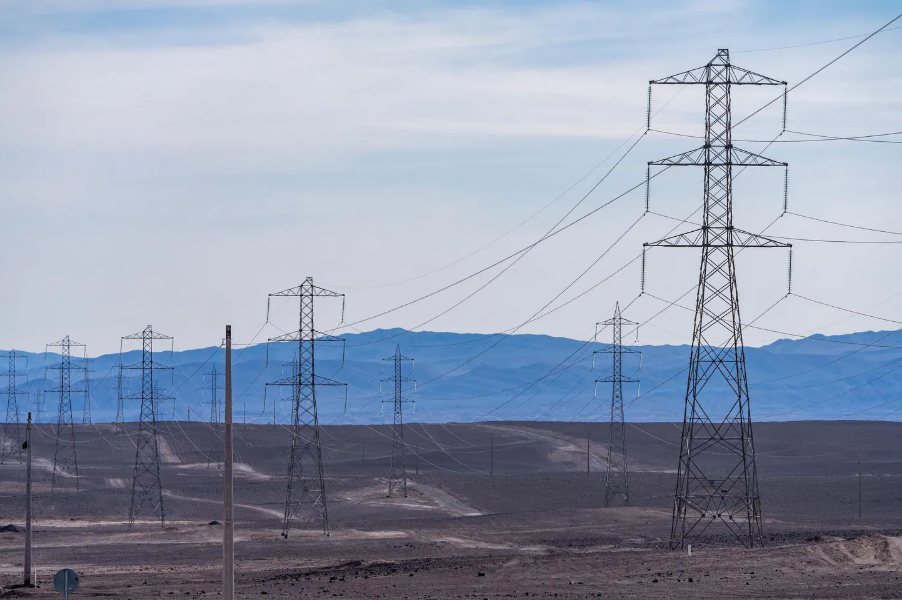
Chile’s energy story over the past decade has been one of remarkable success overall but it is today facing a structural bottleneck. While generation capacity has scaled faster than almost anyone projected, the infrastructure to move that power has not kept pace. The new government has moved decisively to tackle this challenge with a strategic roadmap and a piece of legislation moving through Congress this month that aims to get back on track with the private sector.
A system that outgrew itself
The scale of the shift is hard to overstate. Non-conventional renewable generation now accounts for 52% of total installed capacity on Chile’s national grid (SEN), and renewables provided 41% of all electricity generated in the first eight months of 2025 — up from essentially zero just over a decade ago. In December 2024, wind and solar alone briefly supplied 42%of the country’s electricity in a single month, a record at the time.
However the country also experienced a major setback on February 25, 2025, when a transmission line failure between Maintencillo and Pan de Azúcar triggered a total shutdown of the national grid, cutting power to nearly 8 million homes across 2,400 kilometers of coastline. The blackout was the starkest possible illustration of a system whose generation side had transformed faster than its transmission backbone.
The clearest articulation of the underlying problem came not from a government document, but from a conference panel last week. Engie Chile's Juan Villavicencio offered a memorable framing:
“Chile's energy system is like a circulatory system in which the heart — generation capacity — has grown faster than expected, while the arteries — transmission — have not kept pace”
Where Chile’s energy comes from today
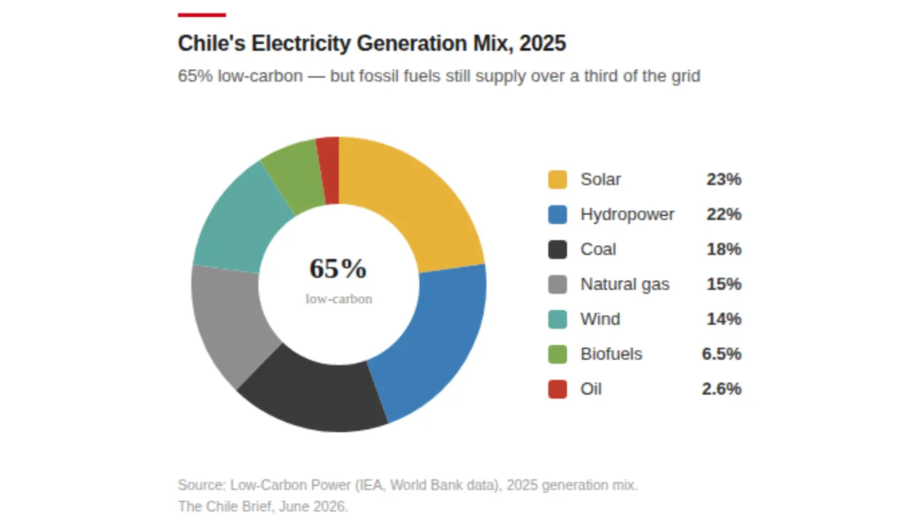
Chile's generation mixtoday reflects that transition mid-stride: solar (23%) and hydropower (22%) lead, with wind close behind (14%), but coal (18%) and natural gas (15%) still supply more than a third of the grid. The U.S. Commercial Service's own assessmentis blunt about the implication: "current electricity production has outpaced grid capacity, leading to energy loss". The government's own target is to push renewables to 70% of consumption by 2030, up from today's 41%.
The roadmap set for 2030
In this context, energy Minister Ximena Rincón presented in late May “Ruta Energética 2026-2030", the government’s roadmapstructured around six strategic pillars: more competitive tariffs, a secure and resilient system, the energy transition itself, enabling transmission infrastructure[…]