

The EU–Mercosur Agreement: A Business Opportunity Guide
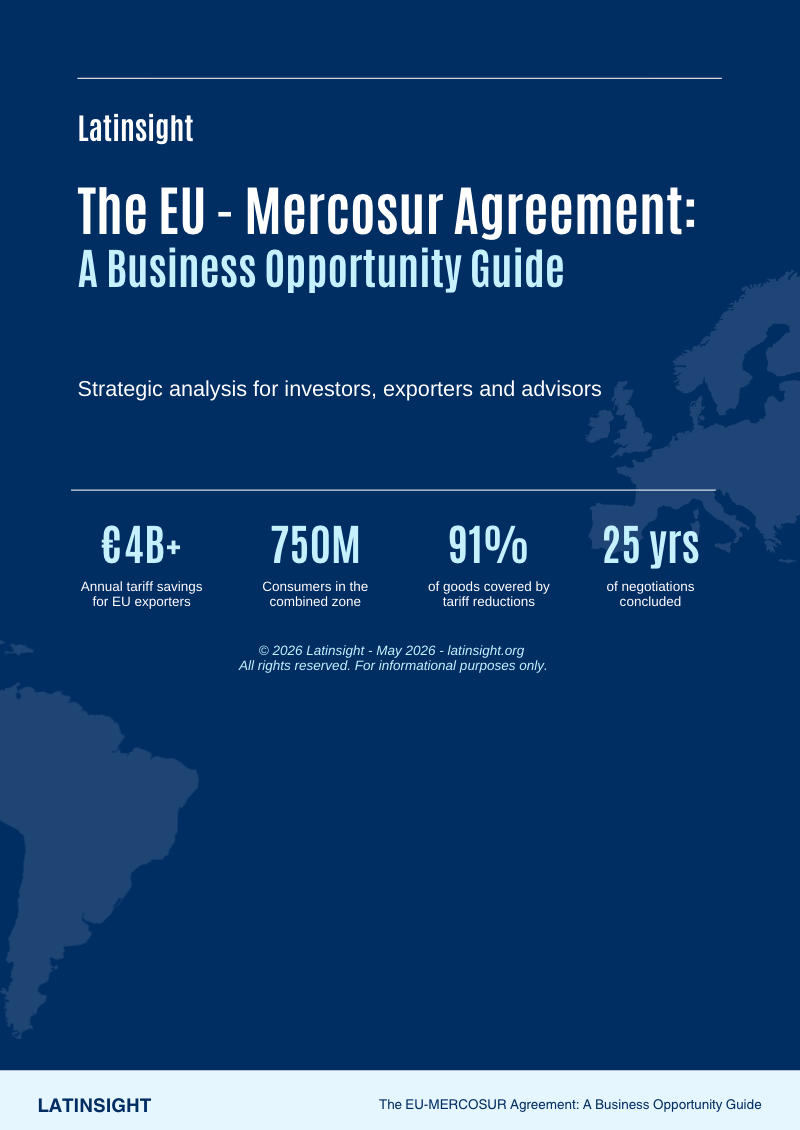
From political agreement to operational framework — what companies need to do now.
May 2026 - 25 pages
Subscribe for free to Latinsight publications to access the report
Executive Summary
The EU–Mercosur agreement is no longer a negotiation to monitor — it is now an operational framework.
Since 1 May 2026, companies can claim preferential tariffs from day one, provided they comply with rules of origin and regulatory requirements.
While political debates continue, the real question for businesses has shifted:
Not whether to engage, but how to capture first-mover advantage.
Key takeaways:
Tariff reductions are now active across multiple sectors, creating immediate export opportunities
EU exports to Mercosur could increase by up to 39%, but gains will be unevenly distributed
Strategic sectors include agribusiness, pharmaceuticals, critical minerals, and services
Brazil represents over 80% of EU–Mercosur trade flows, making it the primary entry point
Political and regulatory risks remain, but do not alter the short-term operational reality
Why This Agreement Matters Now
This agreement is not just another trade deal — it changes how companies operate between Europe and South America.Tariffs are being reduced, markets are opening, and regulatory frameworks are becoming more predictable.But the real impact is strategic: Companies that move early will benefit from first-mover advantages in markets that were previously difficult to access.

Where the real opportunities are
The opportunities created by the agreement are not evenly distributed.
They are concentrated in a few key sectors where competitive dynamics are already shifting.
Agribusiness & Food: Growing demand and progressive tariff elimination are opening new export channels for European producers, particularly in premium segments.
Energy & Critical Minerals: Latin America is becoming strategic for Europe’s energy transition, with strong demand for lithium, copper and long-term supply partnerships.
Pharmaceuticals & Healthcare: Market access is improving, especially in large economies such as Brazil, creating new opportunities for European firms.
Services & Digital: Financial services, telecom and digital activities are benefiting from clearer rules and increasing market openness.
A region of contrasted opportunities
Understanding Mercosur requires a country-by-country approach.
Brazil dominates the region and represents the main entry point
Argentina offers high potential but remains politically volatile
Uruguay stands out as a stable and accessible hub
Paraguay is emerging as a low-cost, investment-friendly market
There is no single strategy for Mercosur — only targeted approaches.

What this means in practice
Companies do not need to master the entire agreement. They need to understand where to act and how to position themselves.
For exporters:
Identify priority markets and products
Anticipate tariff reductions
Adapt pricing and distribution strategies
For investors:
Focus on energy, infrastructure and industrial projects
Integrate regulatory and political risk into planning
Who this report is for
This report is designed for decision-makers involved in international development:
Export managers
Business developers
Investors and analysts
Policy and economic advisors


About the Author
A specialist in Latin American market dynamics, I bring over ten years of dedicated experience analyzing the complex political, economic, and geopolitical landscape of the region.
My academic background at institutions like IHEAL, IRIS, and the University of Tours, complemented by studies at Universidad de la República in Montevideo, provided a rigorous focus on Latin America's positioning within global trade dynamics and geopolitical challenges.
Currently based in Chile, I leverage my on-the-ground insight to understand market entry dynamics and strategic positioning across key sectors, including mining, renewable energy, agriculture, healthcare, and transportation. Latinsight is my platform for independent analysis. It is built on analytical rigour and editorial independence.
Disclaimer: the opinions and views expressed in this publication are solely those of the author. They do not represent, and should not be interpreted as representing, the official positions of any organization with which the author is or has been affiliated.