Colombia’s Energy Elections
Bolivia is in the midst of a significant social crisis that is a convergence of three distinct pressures: a decade-long structural deterioration of hydrocarbon revenues, a reform programme that has accelerated the cost of adjustment, and the lasting influence of former President Evo Morales over the country's politics. Understanding the three together is essential for any assessment of what happens next.
Gustavo Petro’s record
Petro arrived in August 2022 as Colombia's first left-wing president, with a mandate to reduce inequality, negotiate peace with armed groups, and transition the economy away from fossil fuels. On social policy, the record is unambiguous: the minimum wage rose by a cumulative 73% over four years, and public investment reached over 1,000 municipalities that had never seen state presence. Conditional cash transfers were expanded and a landmark tax reform — the first to target high earners and extractive industries — passed in 2022.
The macro consequences were less benign. Public debt, which had already surged during the pandemic, reached 54.4% of GDP by 2024, with the IMF projecting a further rise to 55.5% in 2026. This has left the incoming government with limited fiscal room. Growth collapsed to 0.6% in 2023, driven by a 25% fall in investment, before recovering modestly to around 2.5% in 2025. The "Total Peace" initiative, Petro's flagship security policy engaging armed groups including ELN, FARC dissidents, and criminal cartels simultaneously, effectively collapsed. A FARC dissident bomb attack on the Pan-American highway killed 20 people in April 2026, illustrating the limits of a negotiation strategy that critics argued rewarded armed actors without extracting meaningful concessions. Petro's approval recovered to near 50% in early 2026 on the back of wage increases, but had fallen back to 33% by February as security deteriorated.
The energy crisis beneath the surface
The most consequential legacy of the Petro years is neither the debt nor the peace process. Colombia's oil production fell from over one million barrels per day in 2015 to 714,246 barrels per day in April 2025, the lowest level since the pandemic lows of mid-2021. The mechanism is structural: Petro banned new hydrocarbon exploration contracts and prohibited hydraulic fracturing upon taking office, halting the pipeline of new projects that would have replaced ageing fields. Over 80% of current production comes from fields that have exhausted more than 50% of their initial reserves. Rystad Energy projects output could fall a further 16% between 2025 and 2028, reaching approximately 640,000 barrels per day under current policies.
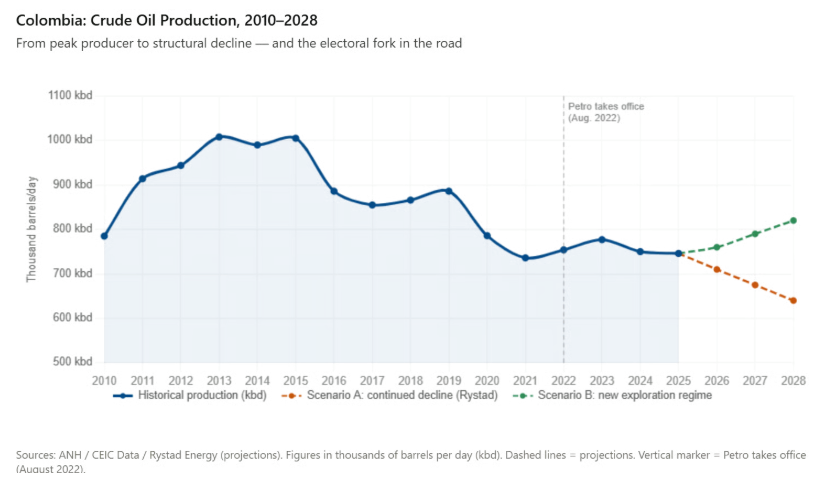
The fiscal implications are direct. Natural gas output hit its lowest level in decades in early 2026, forcing Colombia to ramp up costly LPG imports. Analysts estimate that in 2026, a quarter of all natural gas consumed in Colombia will be imported. This would represent a structural shift with significant consequences for the agricultural and manufacturing sectors that depend on it as a primary fuel. The national oil company Ecopetrol is developing alternative revenue sources — in renewables and through international partnerships. But the company’s transfers to the state budget, a central pillar of Colombian public finance for decades, are under sustained pressure as production declines.
Beyond energy, the next president will also inherit a complex set of foreign policy decisions: Colombia's stance toward Venezuela, its relationship with the Trump administration, and its role in regional security frameworks. On this subject, the outcome of the first round should allow us to better understand the different possible trajectories.
Subscribe to Latinsight publications for free and access a EU-Mercosur Business Opportunity Guide
Three candidates, two visions
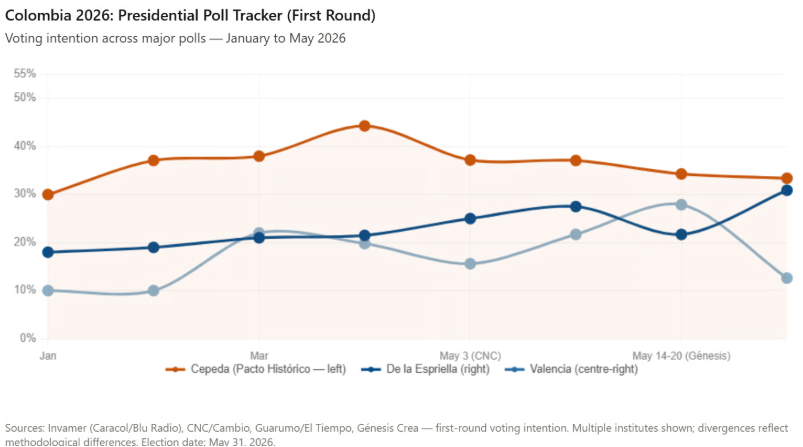
The race has consolidated into a three-way contest. Iván Cepeda of the Pacto Histórico commands 33-44% in first-round polls depending on the institute, with De la Espriella rising sharply to 21-31% and Valencia fluctuating between 13-28% — a dispersion that reflects genuine uncertainty about who reaches the second round. The divergence between polling firms is itself a signal: with five days to the first round, Colombia's electoral race remains analytically unresolved.So far, runoff scenarios consistently show Cepeda losing to either De la Espriella or Valencia in a head-to-head contest — with Valencia defeating him 44.8% to 39.9% in a Guarumo/El Tiempo poll. The strategic question for the right is therefore not whether it can win a runoff, but whether it can consolidate enough around one candidate to reach it.
On energy, the divide is clear. A Cepeda victory means policy continuity: no new exploration licenses, an accelerating reserve depletion trajectory, and a government that will need to find alternative fiscal revenues as oil income shrinks further. Both De la Espriella and Valencia have signalled openness to reversing the exploration ban and reopening fracking discussions — though neither has published a detailed energy programme. If current policies are maintained, Colombia could face export revenue losses of $5-7 billion annually by 2030 and a fiscal adjustment that would require either alternative revenues or significant spending reductions.
🎯 Strategic perspective
The May 31 result is the most consequential near-term event for any company or investor with Colombian energy exposure.The election is shaping up to be very close so far. The first round should shed more light on the situation, particularly on which faction of the right wing has the most support and whether the left-wing candidate Cepeda manages to build a significant lead. The second round, scheduled for late June, is where the definitive signal will come.A right-wing victory could trigger a rapid move to reopen exploration — Ecopetrol's share price and the broader upstream sector would respond positively. A Cepeda victory implies continued production decline, rising import costs, and a government that will need to cover growing fiscal gaps through the private sector.